Application guides
Roofing Nail Selection Guide: Head, Shank, Length and Finish
Choose roofing nails by roofing material, substrate, head form, shank type, dimensions, washer configuration and corrosion exposure.
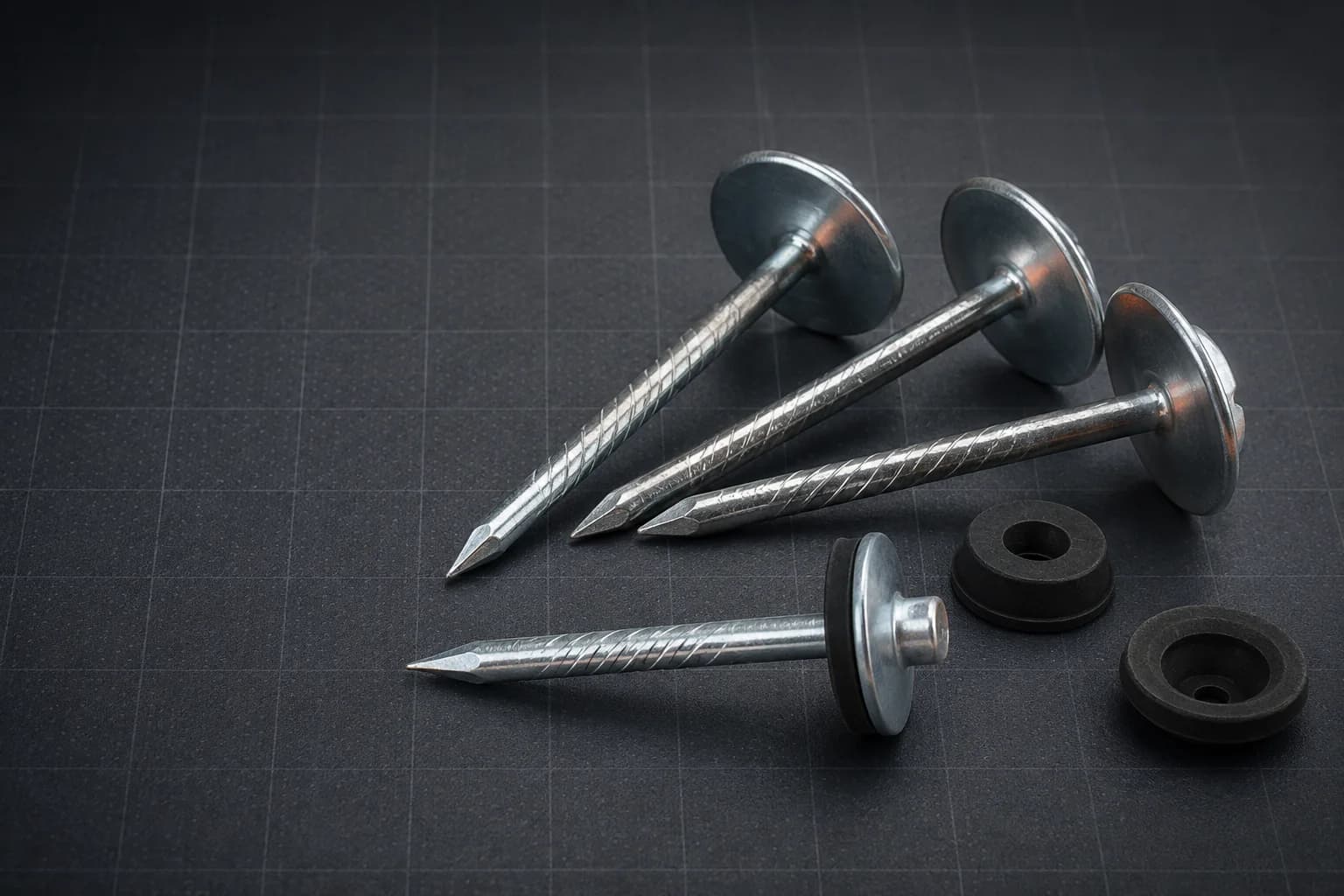
Roofing nails are not selected by length alone. Roof covering, deck or framing substrate, head area, shank profile, corrosion exposure and any sealing requirement work together.
Use this guide to prepare an RFQ, then confirm the final fixing pattern and product specification with the roofing-system designer or manufacturer.
1. Identify the roof covering and substrate
A fixing for roofing felt into timber is not automatically suitable for metal sheet, fibre-cement products or exterior cladding. Name both the top material and the supporting substrate, including thickness where relevant.
- Roof covering type and thickness
- Timber, steel or other substrate
- Number of layers being penetrated
- Indoor, sheltered or exposed location
2. Select the head and washer configuration
Broad clout heads distribute load over felt and sheet materials. Umbrella heads are associated with specific sheet-roofing applications. A sealing washer is configuration-dependent and should be stated explicitly rather than assumed from the product name.
| Feature | Selection question |
|---|---|
| Head form | How much bearing area does the covering require? |
| Head diameter | Does the roof-system specification set a minimum? |
| Washer | Is a bonded or separate sealing washer required? |
| Profile | Must the head match a corrugation or accessory? |
3. Match the shank to withdrawal requirements
Plain shanks are easy to drive, while ring and screw shanks are used where greater withdrawal resistance is specified. The correct choice depends on substrate and system approval, not on a general assumption that more aggressive shanks are always better.
- Plain shank
- Ring or annular shank
- Screw or twisted shank
- Smooth, barbed or project-specific profile
4. Confirm dimensions and corrosion protection
State shank diameter, overall length and head diameter. Length must provide the penetration required by the roofing system after passing through the covering and any intermediate layers. Select galvanized, stainless or another approved finish for the actual exposure.
- Shank diameter
- Overall length
- Head diameter
- Required substrate penetration
- Material, coating and coating test
5. Roofing nail RFQ checklist
Include a photograph or drawing when the head, washer or shank is unusual. Packaging details also matter for manual versus pneumatic installation, even when the nail geometry is the same.
- Roof material and substrate
- Head, shank and washer form
- Diameter and length
- Material and finish
- Quantity, packaging and installation method
Frequently asked questions
Are all roofing nails supplied with washers?
No. Washer type and inclusion depend on the product and roofing system. State it explicitly in the inquiry.
Are ring-shank nails always preferable?
They offer different withdrawal behaviour, but suitability depends on the substrate and approved roofing-system specification.
Specification note
This article is general procurement guidance. The current standard edition, approved drawing and project engineer’s requirements control the final product selection.